
ROLLER CHAIN
The Premier Manufacturer of High-Performance Roller Chains in Brazil & Global Markets

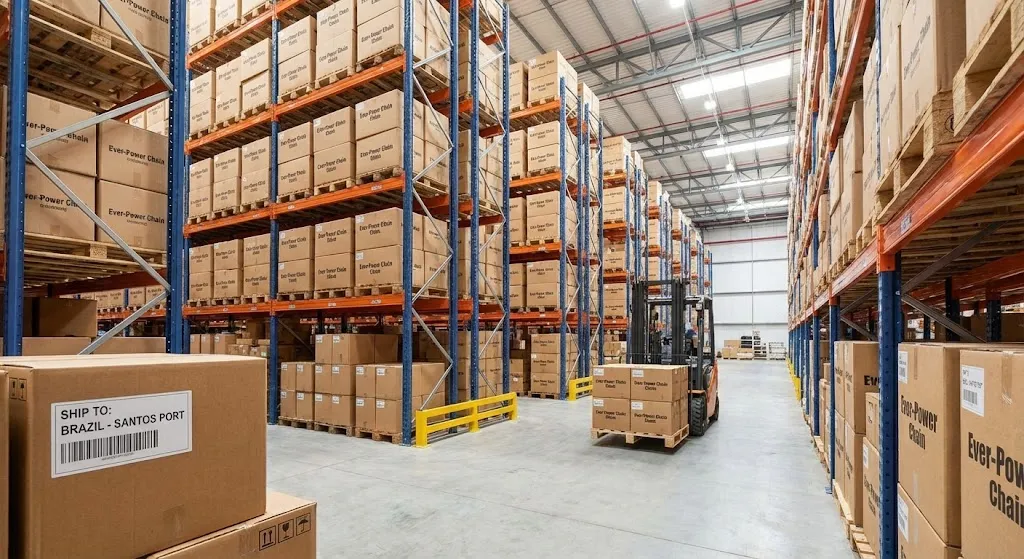
Why Ever-Power is Your Trusted Chain Partner
- Global Standard Compliance: We manufacture strictly to ANSI B29.1 (American), ISO 606 (European/International), and DIN 8187 standards, ensuring 100% interchangeability with brands like Tsubaki and Renold
. -
Brazilian Industry Focus: Our chains are specifically treated to withstand the high-humidity, high-dust environments of Brazilian agriculture and heavy industry, utilizing advanced shot peening and pre-stretching technologies
. -
Direct Manufacturer Value: By eliminating middlemen, Ever-Power provides OEM-grade quality at competitive factory-direct prices, offering a robust supply chain solution for South American and Global markets
.
Capacity & Material & Precision
-
Capacity: 10,000,000 meters of chain produced annually.
-
Material: Premium Alloy Steel (40Mn, 42CrMo) ensuring high fatigue strength
. -
Precision: Components manufactured with tolerances within ISO/DIN class accuracy
.
Stock & Warranty
- Stock: 50,000+ SKUs ready for immediate dispatch from our distribution hubs.
-
Warranty: Industry-leading 12-month performance guarantee on all drive chains.
Engineering Excellence: Why Our Chains Last Longer
Material Selection & Metallurgy (The Foundation)
-
Plates: 40Mn / 45Mn Alloy Steel. Heat-treated to HRC 40-50 for impact resistance
. -
Pins: 30CrMnTi / 42CrMo. Case-hardened to HRC 58-62 (Surface) to resist wear while maintaining a tough core to absorb shock
. -
Bushings & Rollers: 20CrMnTi / 10# Steel. Nitro-carburized for exceptional surface hardness and reduced friction coefficient
. -
Stainless Steel Options: AISI 304 for food-grade applications and AISI 316 for chemical resistance
.
Advanced Heat Treatment Technology
-
Carburizing: We use computer-controlled furnaces to ensure uniform carburization depth (0.8mm – 1.5mm depending on size)
. -
Shot Peening: All link plates undergo shot peening to increase fatigue resistance, critical for high-speed drives.
-
Pre-Stretching: Every chain is pre-loaded to 30-45% of its breaking load during manufacturing to eliminate initial elongation (bedding-in) effectively
.
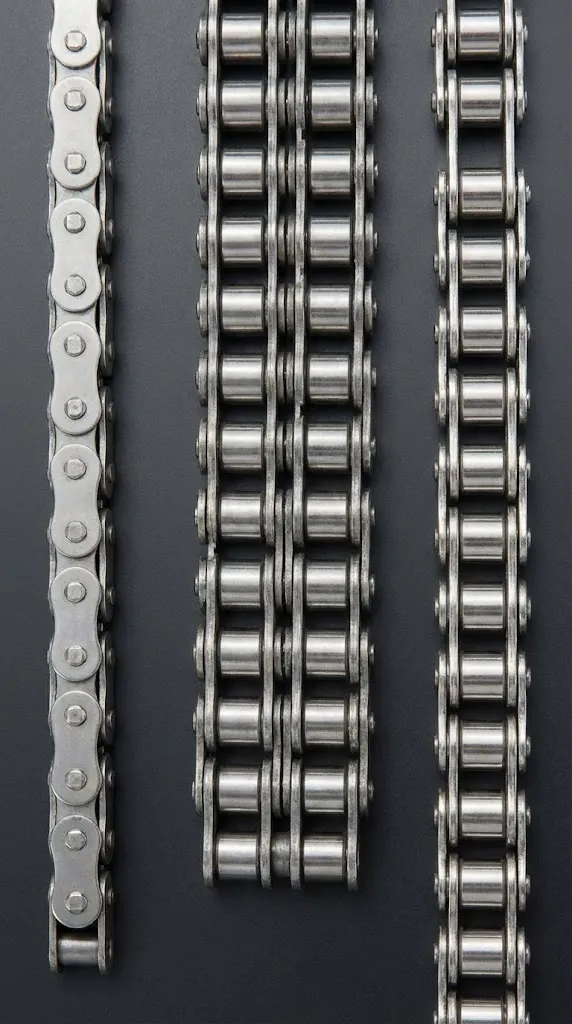
Comprehensive Roller Chain Product Lines
We engineer motion. Explore our diverse range of chains designed for transmission, specialized conveying, and heavy lifting.
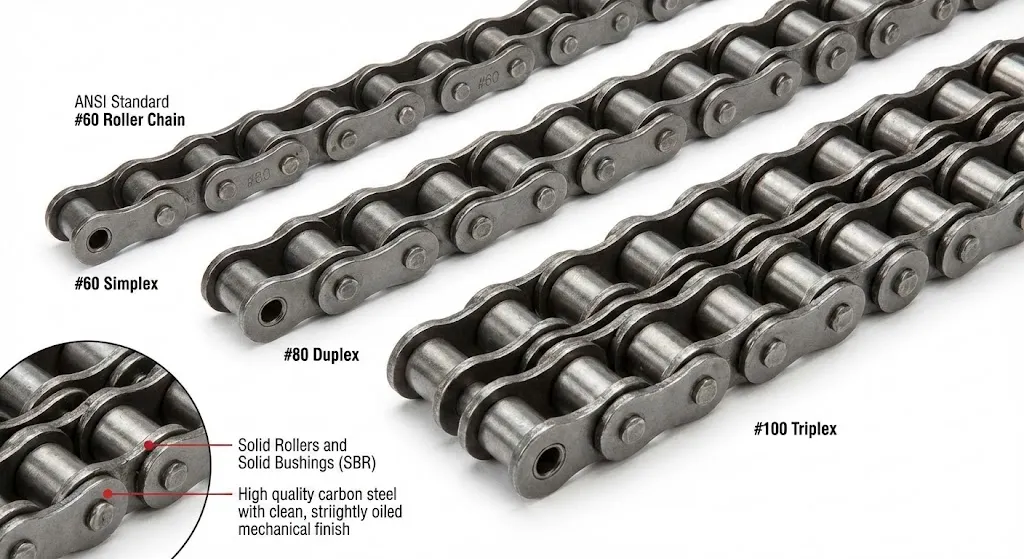
ANSI Standard Roller Chains (American Series)
Our ANSI series (Simplex, Duplex, Triplex) is the standard for North American and Brazilian machinery. Manufactured using AISI 304/316 Stainless Steel or Carbon Steel with hardened pins, these chains are designed to transmit mechanical power efficiently.
-
Models: #25, #35, #40, #50, #60, #80, #100, #120, #140, #160, #180, #200, #240.
-
Engineering Highlight: All ANSI chains feature Solid Rollers and Solid Bushings (SBR) to prevent elongation and increase wear life by up to 30% compared to curled bushing alternatives.
-
Load Capacity: High breaking load verification exceeds ANSI minimum standards by an average of 15%.
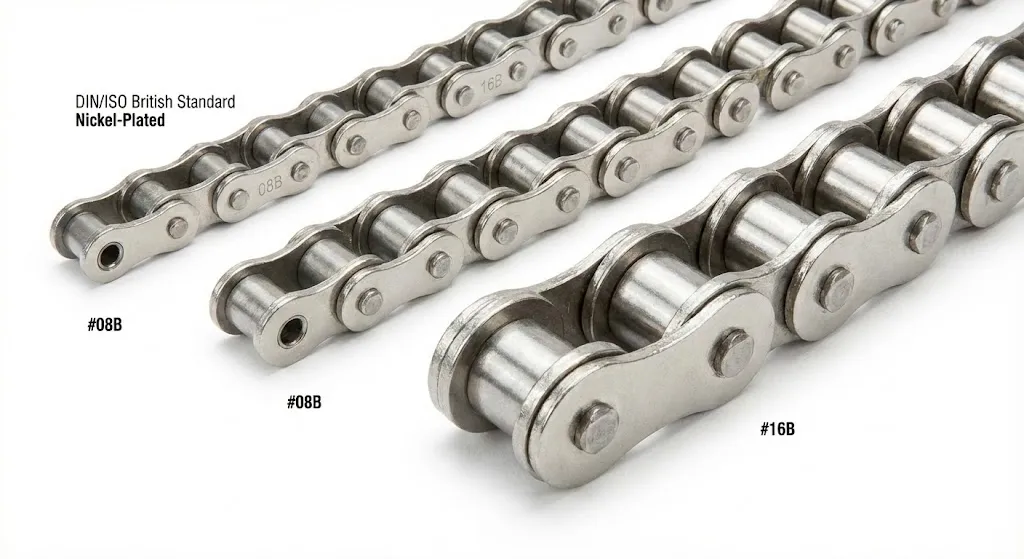
DIN/ISO British Standard Chains (European Series)
Common in packaging, textile, and food processing equipment imported from Europe to Brazil. Our British Standard chains (06B to 72B) feature specific pin diameters and plate thicknesses tailored for DIN sprockets.
-
Models: 04B, 05B, 06B, 08B, 10B, 12B, 16B, 20B, 24B, 28B, 32B.
-
Surface Treatment: Available in Nickel-Plated, Zinc-Platedand Dacromet coatings for superior corrosion resistance in humid Brazilian environments
.
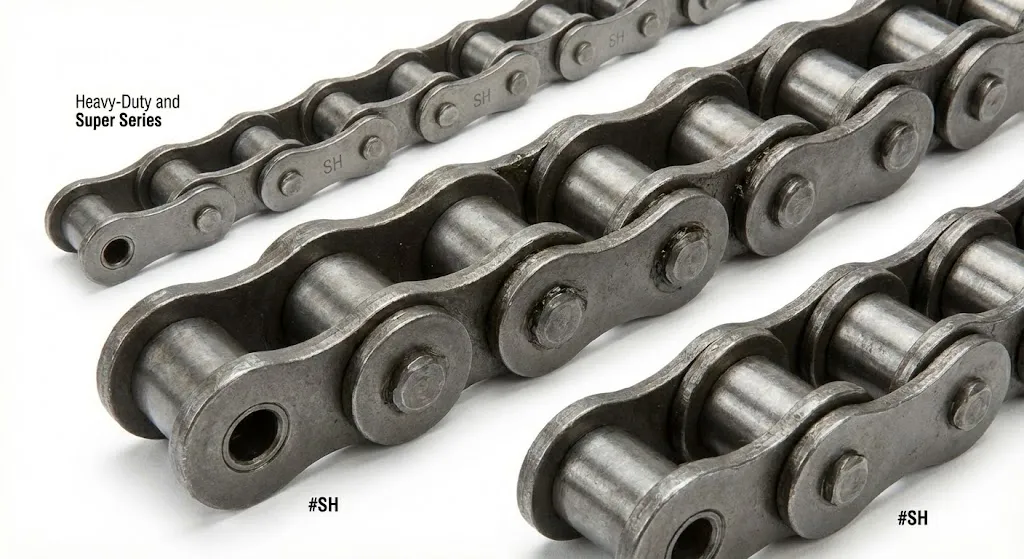
Heavy-Duty & Super Series Chains
When standard chains fail, Ever-Power Heavy Duty (H) and Super Heavy Duty (SH) series prevail. These chains feature thicker link plates and through-hardened pins to handle extreme shock loads typical in rock crushers and excavators.
-
Key Features:
-
Thicker Plates: Increased plate thickness reduces stress concentration holes.
-
Higher Fatigue Strength: Shot-peened parts to induce compressive residual stress.
-
Lubrication: Pre-lubricated with high-viscosity, hot-dipped grease for initial run-in protection
.
-
Happy Customers
Years in Business
Locations
Strategic Industry Applications in Brazil & Beyond
Agriculture (Sugar Cane & Soybeans)
Robust chains designed to resist dust, mud, and continuous harvest cycles. Brazil is an agricultural powerhouse. Ever-Power provides:
- Combine Harvester Chains: Reinforced feeder house chains compatible with John Deere, Case IH, and New Holland machinery
. -
Sugar Cane Chains: Special heavy-duty conveyor chains engineered to handle the abrasive nature of bagasse and cane stalks.
-
Applicable Machinery: Balers, Rotary Tillers, Seeders
.
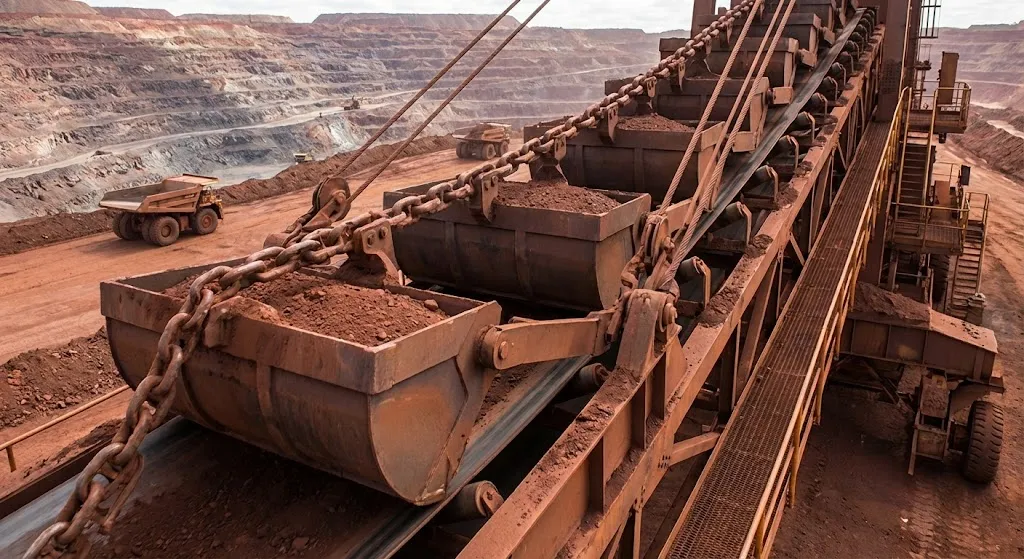
Mining & Cement
Conclusion: Extreme load capacity for the harshest environments on earth. For operations in Minas Gerais and Carajás, we offer:
-
Bucket Elevator Chains: High tensile strength to lift heavy ore loads vertically.
-
Reclaimer Chains: Designed for stacker-reclaimers handling iron ore and bauxite.
-
Protection: Specialized sealing technologies to prevent abrasive dust from entering the pin/bushing contact area.
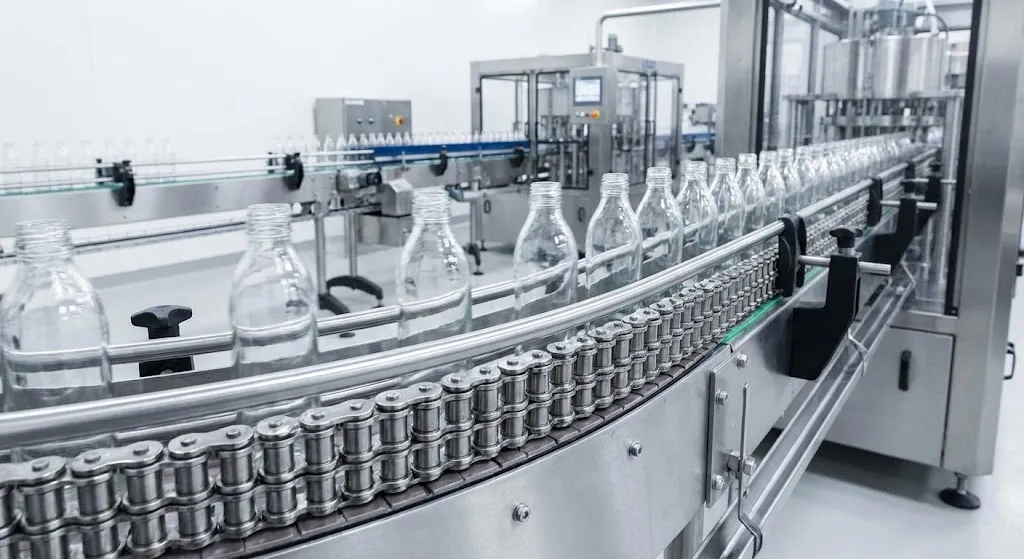
Industrial Automation & Packaging
Conclusion: Precision and cleanliness for high-speed production lines.
- Lube-Free Chains: Sintered bushing chains (Oil-impregnated) for food packaging where oil contamination is prohibited.
-
Corrosion Resistant: Nickel-plated chains for beverage bottling plants.
Installation & Maintenance Guide
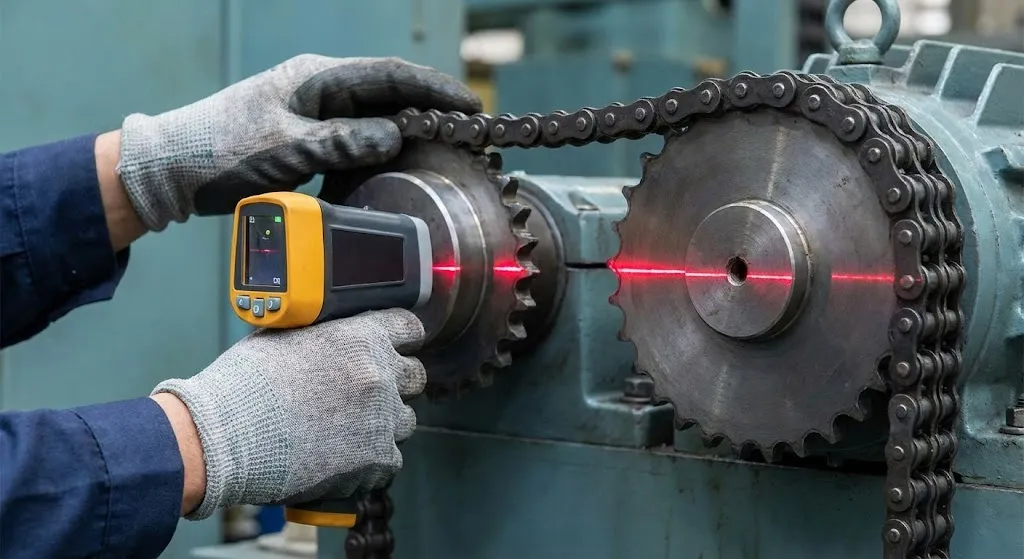
Step 1: Alignment Inspection
Misalignment is the #1 cause of premature chain failure. Before installing the chain, check the shafts and sprockets. Shafts must be parallel, and sprockets must be aligned axially. Use a straight edge or laser alignment tool. Max misalignment should not exceed 0.5mm per meter.
Step 2: Chain Tensioning
Proper slack is essential to prevent bearing load or chain jumping. Install the chain and adjust the center distance. The correct slack (sag) on the slack span should be approximately 2% to 4% of the center distance.
-
Too tight: Increases wear on bearings and chain joints.
-
Too loose: Causes vibration and risk of chain jumping the sprocket teeth.
Step 3: Lubrication Application
Lubrication fights wear, corrosion, and heat. For manual lubrication (Category A), apply oil to the edges of the link plates where they meet the bushings. Do not just coat the outside of the chain; the oil must penetrate the pin/bushing joint
Associations
|
Parameter Parameter |
Specification Specification |
Standard Standard |
|---|---|---|
| Material | Carbon Steel, Stainless Steel (304/316), Alloy Steel | AISI / SAE |
| Hardness (Pin) | HRC 58 – 62 (Case Hardened) | ASTM E18 |
| Hardness (Plate) | HRC 40 – 50 | ASTM E18 |
| Tensile Strength | Exceeds ISO 606 Minimum by 15-20% | ISO 606 / DIN 8187 |
| Pre-Stretch | 30% – 45% of Rated Load | Internal Process |
| Temperature Range | -20°C to +150°C (Standard Grease) | – |
| Standard Length | 10ft (3,048m) or 5 meters / Custom Reels | – |
| Lubrication | Hot-dipped Petroleum-based Grease/Food Grade Oil | SAE Grade 30-50 |
| Accuracy Class | Class 1 / Class A | DIN / ISO |
Frequently Asked Questions (FAQ)
Expert answers regarding roller chain specifications and maintenance.
Q1
What is the difference between ANSI and DIN roller chains?
THE: ANSI (American National Standards Institute) chains follow the B29.1 standard and are measured in imperial units (inches). DIN (Deutsches Institut für Normung) chains, or British Standard, follow ISO 606 and are measured in metric units. They have different pitch, roller diameters, and plate widths. They are NOT interchangeable sprockets.
Q2
How often should I lubricate my roller chain?
THE: It depends on the environment and speed. For manual lubrication, typically every 8 hours of operation or whenever the chain appears dry. For oil bath systems, check oil levels weekly. If the chain shows a reddish-brown color (fretting corrosion), it is under-lubricated.
Q3
Can Ever-Power chains handle high-temperature environments?
THE: Standard carbon steel chains are rated for up to 150°C. For higher temperatures (eg, ovens, furnaces), we offer Stainless Steel chains (up to 400°C) or specialized chains with high-temp grease and heat-treated alloys.
Q4
How do I measure chain elongation?
THE: Chain wear is measured by elongation. Measure a span of at least 6-10 links. If the length has increased by more than 1.5% to 2% over the nominal pitch length, the chain should be replaced to prevent sprocket damage.
Q5
Do you ship directly to Brazil?
THE: Yes, we are a premier supplier for the Brazilian market. We handle logistics to major ports (Santos, Paranaguá) and offer DDP (Delivered Duty Paid) terms for qualifying orders, simplifying the import process for you.